Ceviche – An Origin Story
A Peruvian raw fish dish dating back over a millennium, though simple, has many iterations, all infused with patterns of social movements.

Across South America, ceviche – raw fish cured in citrus –is a dish that epitomises the blending of cultures and social patterns that define Peruvian cuisine and the continent as a whole. The origins of the dish date back over a millennium, pre-dating Incan civilisations - the word ‘ceviche’ may have originated from ‘siwichi’, meaning fresh fish in Quecha, one of Peru’s indigenous languages. But it was as Spanish and Asian influences fed into Peruvian cuisine that various iterations of ceviche ensued and spread throughout the continent. Now inscribed on UNESCO's Representative List of the Intangible Cultural Heritage of Humanity, the dish has embedded itself into the Peruvian national consciousness. There are now thousands of cevicharias – ceviche restaurants across Peru, emblemmatic of the nation’s rich history of immigration and ethnic diversity.
In Peru, from the major artery of the Amazon winding through the Andes and deep into the jungle, indigenous groups settled across these geographic pockets. In coastal cultures, fish and shellfish were a vital diet. Archaeological evidence points to the Moche people (pre-Inca civilization) eating fish straight out of the sea, partly cured with the acid from tumbo juice – something akin to a passionfruit – combined with chilli or seaweed. The the roots of ceviche, the raw fish marinating in acid, are entirely entangled with Peru’s coastal cultures and what was naturally abundant.
Today, when we think of ceviche, we might think of fish, coated in lime juice, salt, chilli, and finely diced onion. But beyond marinated fish and chilli, these components are the product of the Colombian Exchange – where Spanish and Portuguese settlers exchanged crops and livestock, among which were citrus trees and alliums. This transfer permanently altered the culinary landscape in the Americas, and layed the foundation for what we now recognise as ceviche.
At its core, ceviche is a method of marination. Immersing the fish in citrus results in a ‘cooking’ process called denaturation: the acid lowers the pH of the fish, causing the proteins to re-form, turning the fish opaque and firm. Historically, the raw fish would have been left in lime juice for a much longer period – 12 -14 hours – to help kill some of the bacteria. With such a lengthy process, the texture is transformed; the proteins in the fish firm into something tougher and rubberier than the ceviche we’re used to today.
With the emigration of Japanese diaspora in the 20th century, ceviche took on a new iteration. The cuisine Nikkei - the Japanese word for emigrants - became embedded in Peruvian cooking. Though small in population - only 1% of Japanese immigrants remain in Peru - the enduring cultural influence far outweighs the size. Peruvian flavours such as pisco - a fiery, brandy-like spirit - and the native purple potato are woven throughout Nikkei cuisine and reinterpretated in traditional dishes like ‘causa’ - a layered potato dish. This cultural exchange went both ways; soy sauce and miso entered Peruvian gastronomy in dishes like ‘lomo saltado’ – a Peruvian beef stir fry.
But it was in the 1970s that renown chef Nobu Matsuhisa, founder of Nobu, opened his first restaurant in Peru and with it popularised a reinvented version of ceviche that would go on to become a global dish. Japanese techniques and refined culinary skills -such as sashimi preparation and an ethos of celebrating fresh, raw fish - transformed traditional ceviche into a lightly cured, more delicately flavoured dish. Nobu invented ‘tiradito,’ a signature dish of Nikkei food, by mixing thinly sliced raw fish with lime juice and Peruvian peppers.
This enduring legacy means that in modern versions of ceviche, the raw fish needs just 30 minutes to ‘cook’ in this marinade, and you’re left with a fiery, citrusy sap called ‘leche de tigre’ or milk of the tiger. There is debate about the appropriate ‘class’ of raw fish to cook with. So-called ‘sushi grade’ fish means very little and seems to be an arbitrary metric, used mainly for marketing purposes. The claim that is only as trustworthy as the fish market that labels it. Then there’s the issue of availability and price. Ultimately, you want the freshest fish you can get. Supermarket fish can be more susceptible to tapeworm. Though I have used it to make ceviche before, it’s probably best avoided. Going to a fishmonger is preferred, or a fish counter at a supermarket.
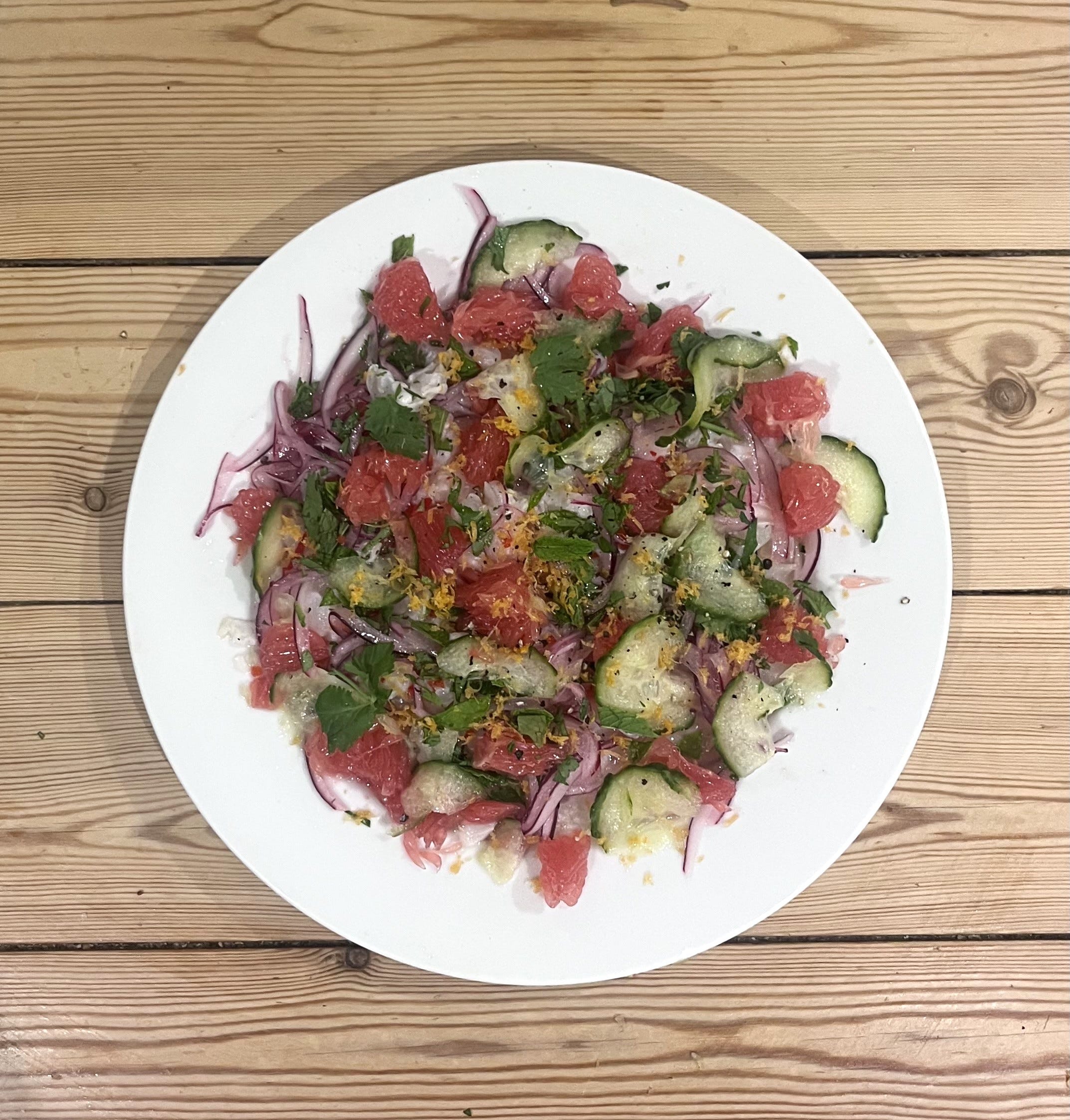
Below, I’ve used Nigel Slater’s ceviche recipe, which incorporates grapefruit and cucumber. Because limes in the UK are less sweet than Peruvian limes, the grapefruit lends a slightly sweeter tartness to the dish.